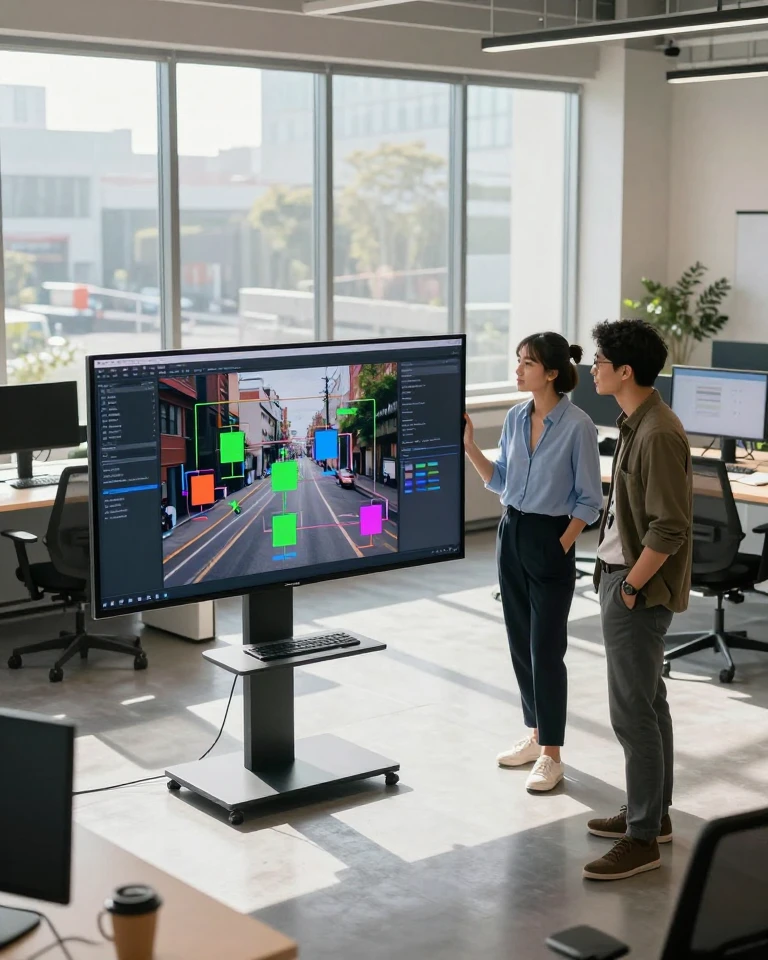
Computer Vision is one of the most exciting fields of Artificial Intelligence (AI) that enables computers to understand, analyze, and interpret visual information from the real world. Just as humans use their eyes and brain to recognize objects, faces, and environments, Computer Vision allows machines to perform similar tasks using cameras, images, and videos.
In recent years, Computer Vision has transformed industries such as healthcare, retail, manufacturing, agriculture, transportation, and security. From facial recognition systems and self-driving cars to medical image analysis and quality inspection in factories, this technology is changing the way businesses operate and improving everyday life.
In this article, we will explore what Computer Vision is, how it works, its key technologies, real-world applications, benefits, challenges, and future trends.
What Is Computer Vision?
Computer Vision is a branch of Artificial Intelligence that focuses on enabling computers to process and understand visual data such as images and videos. It combines machine learning, deep learning, and image processing techniques to identify patterns, recognize objects, detect movements, and make intelligent decisions.
Unlike traditional image processing, which simply modifies images, Computer Vision extracts meaningful information from visual content. The goal is to make computers “see” and interpret images in a way that resembles human vision.
For example, when you unlock your smartphone using Face ID or use Google Lens to identify an object, Computer Vision is working behind the scenes.
How Does Computer Vision Work?
Computer Vision systems follow several important steps to analyze visual information.
1. Image Acquisition
The process begins by capturing images or videos using cameras, drones, smartphones, medical scanners, or surveillance systems.
2. Image Preprocessing
Before analysis, the captured image is improved by reducing noise, adjusting brightness, enhancing contrast, and resizing for better accuracy.
3. Feature Extraction
The system identifies important visual features such as edges, colors, shapes, textures, and patterns.
4. Object Detection and Recognition
Using deep learning algorithms, the system detects and classifies objects such as people, vehicles, animals, buildings, or products.
5. Decision Making
Finally, the extracted information is used to perform actions like identifying faces, tracking movement, diagnosing diseases, or controlling autonomous vehicles.
Key Technologies Behind Computer Vision
Several advanced technologies power modern Computer Vision systems.
Artificial Intelligence (AI)
AI provides the intelligence required for machines to learn visual patterns and make accurate decisions.
Machine Learning
Machine Learning enables systems to improve performance by learning from large datasets without explicit programming.
Deep Learning
Deep Learning uses neural networks with multiple layers to recognize complex visual patterns. It significantly improves image recognition accuracy.
Convolutional Neural Networks (CNNs)
CNNs are specialized deep learning models designed for image classification, object detection, and facial recognition.
Image Processing
Image processing techniques prepare images for analysis by enhancing quality and removing unwanted noise.
Real-World Applications of Computer Vision
Computer Vision has become an essential technology across many industries.
1. Healthcare
Healthcare is one of the biggest beneficiaries of Computer Vision.
Doctors use AI-powered systems to analyze X-rays, CT scans, and MRI images for detecting diseases such as cancer, pneumonia, and brain tumors.
Computer Vision also assists surgeons during robotic surgeries and improves diagnostic accuracy while reducing human error.
Benefits
- Faster diagnosis
- Early disease detection
- Improved patient care
- Reduced workload for radiologists
2. Self-Driving Cars
Autonomous vehicles rely heavily on Computer Vision.
Cameras continuously monitor roads, traffic signs, pedestrians, cyclists, and surrounding vehicles.
Computer Vision enables cars to:
- Detect obstacles
- Stay within lanes
- Recognize traffic signals
- Avoid collisions
- Navigate safely
Without Computer Vision, self-driving technology would not be possible.
3. Facial Recognition
Facial recognition systems identify individuals by analyzing facial features.
Applications include:
- Smartphone unlocking
- Airport security
- Employee attendance
- Banking authentication
- Law enforcement
Modern facial recognition systems achieve high accuracy even under different lighting conditions.
4. Retail and E-Commerce
Retail businesses use Computer Vision to improve customer experiences.
Examples include:
- Automated checkout systems
- Inventory management
- Customer behavior analysis
- Product recommendations
- Shelf monitoring
Many supermarkets now allow customers to shop without waiting in checkout lines, thanks to AI-powered vision systems.
5. Manufacturing
Factories use Computer Vision for quality inspection and automation.
The technology detects:
- Product defects
- Incorrect packaging
- Missing components
- Surface damage
This reduces production costs while increasing product quality.
6. Agriculture
Smart farming has become more efficient with Computer Vision.
Farmers use drones equipped with cameras to monitor crops and identify:
- Plant diseases
- Pest infestations
- Water shortages
- Nutrient deficiencies
These insights help increase crop production while reducing resource waste.
7. Security and Surveillance
Computer Vision enhances public safety through intelligent surveillance systems.
Applications include:
- Suspicious activity detection
- Vehicle identification
- License plate recognition
- Crowd monitoring
- Intruder detection
Modern surveillance systems can automatically alert security teams when unusual activities occur.
8. Sports Analytics
Sports organizations use Computer Vision to analyze player performance.
Applications include:
- Player tracking
- Ball tracking
- Performance analysis
- Match statistics
- Injury prevention
Professional teams rely on AI-generated insights to improve strategies and player fitness.
9. Education
Educational platforms use Computer Vision for:
- Online exam monitoring
- Student attendance
- Gesture recognition
- Interactive learning
This technology creates smarter and more engaging learning environments.
10. Healthcare Robotics
Medical robots equipped with Computer Vision assist doctors during surgeries with remarkable precision.
Robotic systems can identify organs, blood vessels, and tissues while minimizing surgical risks.
Benefits of Computer Vision
Computer Vision offers numerous advantages across industries.
Improved Accuracy
Machines can analyze thousands of images with consistent precision, reducing human error.
Increased Productivity
Automation speeds up repetitive tasks and improves operational efficiency.
Cost Savings
Businesses reduce labor costs by automating inspection, monitoring, and data analysis.
Better Decision-Making
Real-time visual insights help organizations make informed decisions quickly.
Enhanced Safety
Computer Vision reduces workplace accidents by monitoring hazardous environments and detecting safety violations.
24/7 Operation
Unlike humans, AI-powered vision systems can work continuously without fatigue.
Challenges of Computer Vision
Despite its impressive capabilities, Computer Vision still faces several challenges.
Large Data Requirements
Training deep learning models requires millions of labeled images.
Privacy Concerns
Facial recognition and surveillance technologies raise important privacy and ethical questions.
High Computing Power
Advanced Computer Vision models require powerful GPUs and cloud computing resources.
Environmental Conditions
Poor lighting, fog, rain, shadows, and camera angles can reduce system accuracy.
Bias in AI Models
If training data lacks diversity, Computer Vision systems may perform unevenly across different populations or environments.
Future of Computer Vision
The future of Computer Vision looks extremely promising.
Emerging technologies such as edge AI, 5G networks, augmented reality, virtual reality, and generative AI are expanding the capabilities of Computer Vision.
Future innovations may include:
- Fully autonomous transportation
- AI-powered smart cities
- Advanced medical diagnosis
- Intelligent robotics
- Personalized retail experiences
- Smarter manufacturing systems
- Enhanced environmental monitoring
As computing power continues to grow and AI models become more efficient, Computer Vision will become increasingly integrated into everyday life.
Best Practices for Businesses Using Computer Vision
Organizations planning to adopt Computer Vision should follow several best practices:
- Use high-quality image datasets for model training.
- Ensure data privacy and comply with applicable regulations.
- Continuously monitor and update AI models to maintain accuracy.
- Test systems under different lighting and environmental conditions.
- Combine Computer Vision with human oversight for critical decisions.
- Invest in scalable infrastructure to support future growth.
Following these practices helps maximize performance while minimizing risks.
Conclusion
Computer Vision is revolutionizing the way machines interact with the visual world. By enabling computers to recognize objects, analyze images, detect patterns, and make intelligent decisions, this technology is driving innovation across healthcare, transportation, retail, manufacturing, agriculture, security, and many other industries.
Although challenges such as privacy concerns, data requirements, and computational costs remain, ongoing advances in Artificial Intelligence and Deep Learning continue to improve the accuracy and accessibility of Computer Vision systems.
As businesses and researchers push the boundaries of innovation, Computer Vision will play an even greater role in shaping the future of technology. Organizations that embrace this powerful AI technology today will be better positioned to improve efficiency, enhance customer experiences, and remain competitive in an increasingly digital world.